
The hidden cost of AI: who pays the price for South Africa’s data centre boom?
By Hannah Hopper, Mizizi Editorial Associate

As artificial intelligence (AI) and digital technologies expand across Africa, so does the infrastructure needed to support them. What does this growth mean for communities already struggling to access water, electricity and housing? Mizizi Magazine attended a public meeting in Cape Town to explore the social, environmental and human rights implications of South Africa’s growing data centre industry.
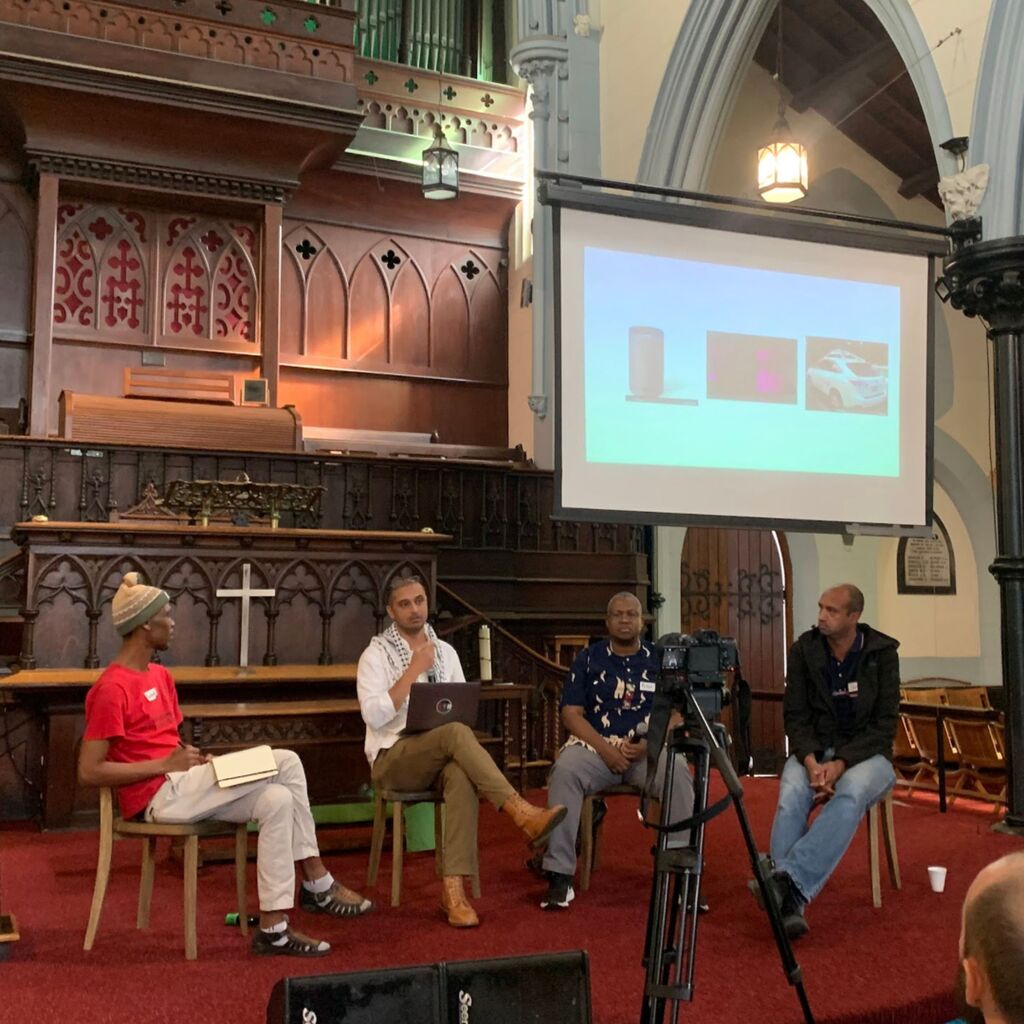
On 26 September 2026, community members, researchers, activists and civil society organisations gathered at Central Methodist Church in Cape Town for a public meeting titled What’s the Deal with Data Centres? The discussion followed the City of Cape Town’s approval of land-use applications for a proposed hyperscale data centre near Cape Town International Airport. The development has raised serious concerns about its potential impact on water, electricity, land use and surrounding communities.
At the heart of the discussion was a simple but crucial question: Who benefits from technological development and who bears its environmental and social costs?
The environmental cost of a digital world
Data centres are large facilities that store and process digital information. They support everything from everyday internet services to the rapid expansion of AI. Although often presented as clean, modern infrastructure, these facilities have a significant physical footprint. They require large amounts of electricity to power their equipment and, depending on their cooling systems, considerable quantities of water to prevent overheating.
According to a civil society report submitted to the South African Human Rights Commission (SAHRC), the proposed Equinix development in Cape Town could consume an estimated 4.4 billion litres of water every year if conventional water-based cooling were used. This is equivalent to the annual water consumption of more than 18 000 South African households.
However, Equinix has stated that its proposed facilities will use dry, air-based cooling systems, which require significantly less water. While actual consumption will depend on the final design, the debate raises important concerns for a city that narrowly avoided running out of water during the 2018 drought. With Cape Town entering the 2026/27 summer with lower dam levels than the previous year and potential water restrictions, questions about how limited water resources are allocated and whose needs are prioritised have become increasingly urgent.
Electricity demand presents another challenge. Although South Africa’s electricity supply has improved following years of load-shedding, concerns remain about the capacity of the grid to accommodate energy-intensive developments such as data centres. The country also remains heavily dependent on coal-fired power, meaning that increased electricity demand could contribute to greenhouse gas emissions unless additional renewable energy is secured. These concerns raise important questions about how electricity is allocated and whether infrastructure can meet the needs of both communities and industry.
Development for whom?
Beyond environmental concerns, the meeting highlighted the social inequalities surrounding large-scale infrastructure development. The proposed facility is located near communities such as Barcelona, Bishop Lavis and Gugulethu, where many residents continue to struggle with reliable access to basic services. Community representatives questioned why substantial resources could be allocated to data centres while nearby households face ongoing challenges accessing water, electricity and adequate housing.
Land use and job creation were also raised as concerns. In a city still shaped by apartheid spatial planning and persistent housing shortages, decisions about land allocation have significant social consequences. While developments of this scale often promise economic opportunities, data centres typically create relatively few permanent jobs. Researcher Mohammad Amir Anwar estimated that the proposed development would generate approximately 120 construction jobs and only 40 permanent positions.
These concerns reflect a wider challenge across Africa: ensuring that foreign investment and technological advancement deliver meaningful benefits to local communities rather than reinforcing existing inequalities.
When consultation becomes a formality
One of the strongest messages from the meeting was the need for meaningful public participation. Community representatives described receiving limited information about proposed developments, with technical documents and notices often difficult to access or understand. Speaking at a separate community meeting on the same day, Bishop Lavis community leader Michael Hoffmeester expressed his frustration with the technical information provided to residents. As reported by GroundUp, he asked: “How can I explain to the community what we were told if I don’t even understand it?”
Housing Assembly and Foxglove, represented by the Legal Resources Centre, have lodged a formal appeal against the City of Cape Town’s approval of the proposed Equinix data centre development at King Air Industria. They argue that the decision was made without sufficient information about its potential environmental and social impacts.
Putting people and the planet first
The meeting also highlighted gaps in South Africa’s regulatory framework. As data centre development accelerates, civil society organisations are calling for stronger oversight, mandatory reporting of water and electricity consumption, and independent assessments of environmental and human rights impacts. Participants emphasised that South Africa has an opportunity to learn from international experiences and establish safeguards before large-scale developments become widespread.
As data centre development expands across South Africa, questions remain about its social and environmental impacts. Gaps in regulation, complex planning processes and limited access to information make public scrutiny difficult. Greater transparency from developers, stronger government oversight and meaningful public participation are essential. Civil society also has an important role to play in raising awareness, questioning decisions and ensuring that these developments remain subject to public scrutiny.
The event was supported by organisations including Foxglove, SAFCEI, Open Secrets, Housing Assembly, the Legal Resources Centre, Green Anglicans, Living Water and Planetary AI Lab.
Help this story travel further. Share it: